
Exhibition in the Old Church of Delft
DEATH - Remember Me (Part 1)
Remembering is picking up a thought, holding it for a moment, and setting it down again... only to be picked up another time
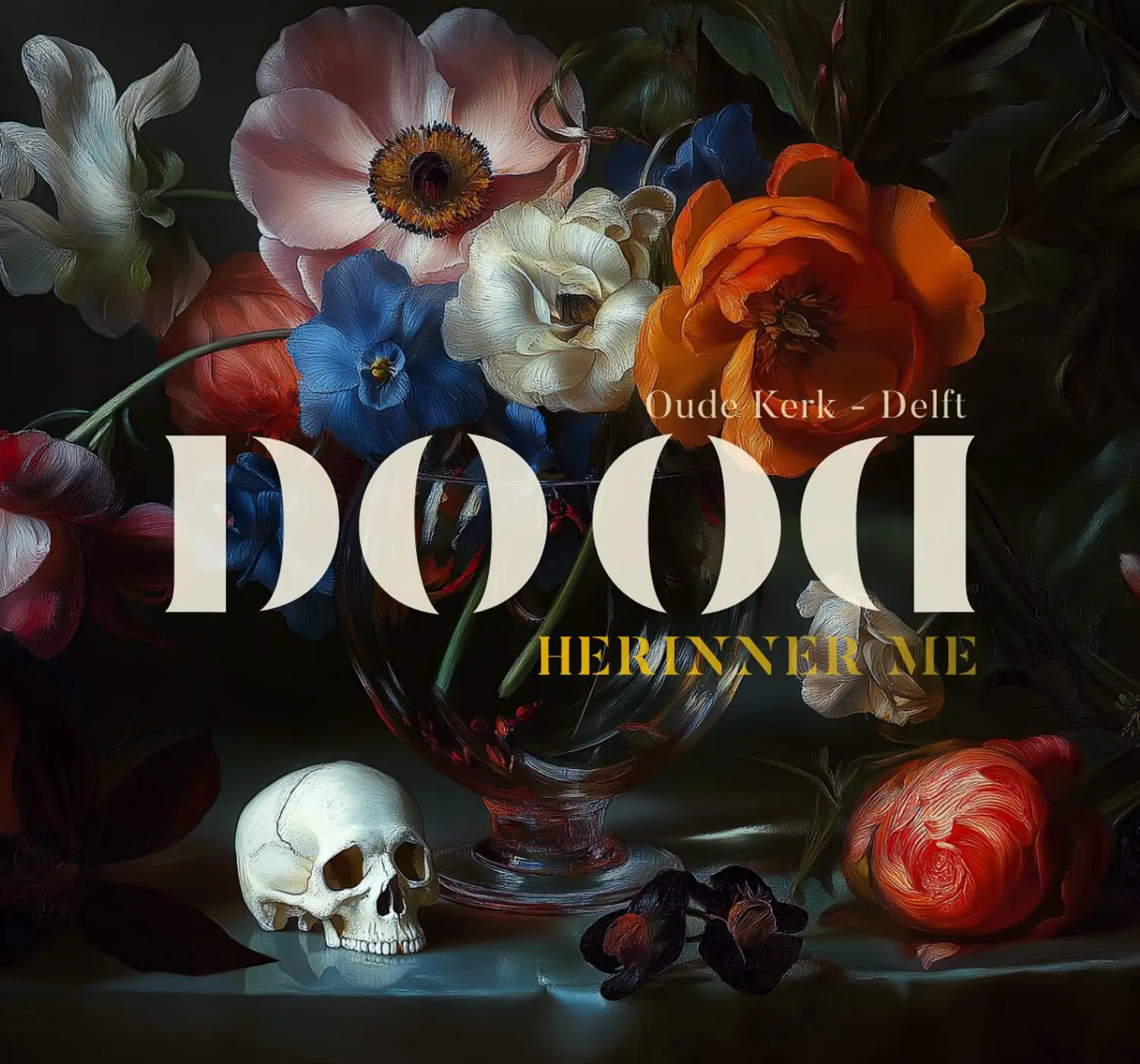
DEATH - Remember Me
Welcome to the Old Church. In this exhibition, we take you on a journey through time, exploring how people throughout the centuries have dealt with death and the commemoration of loved ones.
Throughout history, churches have often played a central role in remembering the deceased. In early Christian tradition, the death of Jesus was commemorated weekly during gatherings. This ritual, known as the Eucharist, means 'thanksgiving or gratitude'. Over time, different ways of remembering the deceased developed.
Some individuals were called 'saints'. Songs were sung for them and relics - pieces of bone, for example - were preserved in churches. But 'ordinary' believers were also remembered in prayers.
However, this exhibition is not just about the past. We invite you to reflect on how we deal with memories of those we miss today.
As you look around, consider: How do you remember those you miss?
And how would you like to be remembered yourself?
MACABRE OR REVERENT
In early Christian tradition, there was a strong sense of connection between the living and the dead. It was believed that the souls of the deceased were 'living with God'. They were still there! And one could still look with reverence at what remained of them, the body. For humans were created by God, such was the belief.
This notion of connection is still visible in this Old Church of Delft, for example through the graves and also images of skulls. To us now, this might feel somewhat macabre. But at the time, these symbols were a sign of respect and reverence. A skeleton or an image of one was not meant to inspire fear, but served as a reminder of life's temporality and the transition to what was seen as eternal existence.
ETERNAL LIFE
In Christian tradition, the skull does not only symbolise death, as you might know from pirate flags.
It was also very much a symbol of hope. For believers, it served as a reminder of the promise of peace, resurrection and eternal life, as described in the Bible. This symbolism offered comfort and perspective in times of loss.
LOVE FOR THE DEAD
We remain connected to our loved ones, even after they have passed away. This can be a particularly comforting thought!
For the first Christians, the resurrection of Jesus symbolised the victory over death. And with that, death was no longer the end! An ancient Christian hymn expresses this as follows:
'Christ is risen from the dead, trampling down death by death, and upon those in the tombs bestowing life.'
It was believed that after death, the souls of believers continued to live in God's presence. They were therefore not dead, but lived on, and thus the bond with the deceased remained.
This belief provided comfort and hope in times of loss.
Although not everyone shares these specific religious beliefs, many recognise the desire to remain connected to our deceased loved ones.
'In what ways do you still feel connected to your departed loved ones?'
MEMENTO MORI
One of the main reasons for images of skulls in old churches is the concept of memento mori.
This Latin expression means 'remember that you must die' and served as a reminder of human mortality. It encouraged churchgoers to reflect on the finite nature of life and how they wished to spend their time on earth.
RELICS IN THE CHURCH
In early Christian tradition, it was customary to place a relic on the table at the front of the church. A relic is a remnant of a saint, such as a bone fragment, clothing, or a personal object. This practice originated from holding church services on the graves of martyrs. The relic on the altar reminded people of their connection with the saints and also referenced the sacrifice of those who gave their lives for their faith.
MONEY & STATUS
In many old churches, you'll find ossuaria - spaces where human bones were stored. This often had a practical reason: lack of space in cemeteries. Sometimes the reason for a grave in the church was less spiritual: money and status. Wealthy or influential individuals could acquire a prime spot in the church.
GRAVE POEMS
Two of the grave poems shown here were written by Gregory of Nazianzus, an important figure from the early Christian period. Gregory lived from 329 to 390 in Cappadocia, an area in present-day Turkey. He was a theologian, poet and bishop. In his grave poems, he combined elements from classical Greek poetry with Christian themes. The poems reveal very personal feelings of loss and grief.
OTHER GRAVE POEMS
The other grave poems are of a quite different nature.
The poets reflect on their own legacy or that of another. Sometimes humorous. Sometimes deeply religious.
Gregor
FOR MY SON
We were ripe for the grave,
when the sculptors placed this heavy tombstone here,
for we would soon die.
It was for us that they placed it;
how unjust it is that this stone now lies upon Kaisarios, youngest of all our children.
The most terrible grief has befallen us, my child, oh, my dear child!
But in our grave we shall soon meet, shortly you will receive us, yes, we shall make haste.
Gregory
FOR MY COUSIN
Speaker among speakers, poet among poets, known in his homeland, honoured by his parents.
Only recently did he grow a beard, Eufemios, only recently did love sound in his chamber.
Now he is dead, a great sorrow.
No young bride, but a grave he received, and the day of love became a day of grief.
Hubert Korlesz Poot - 1733
SHORT & SWEET
Here lies Poot
He is dead
He is dead
Gerrit Achterberg - 1962
EPITAPH
From death to death he went, until he died.
Cast off the names, that he'd acquired with pride.
Save for this stone, whereon is written clear: the poet of the verse, that never died.
Willem Bilderdijk - 1805
EPITAPH FOR MYSELF
This narrow tomb contains a poet's ash.
He sang of fatherland, of poetry and passion, oppressed Christian virtue, his trials, God's compassion.
Fortunate, if his song might warm a cold heart's core!
You, who value his art, know his heart and suffering sore,
Thank Jesus, whose grace has ended his lamenting.